You’re sitting at the kitchen table, flipping through flashcards with your toddler. “How many apples?” you ask, tapping the card. Your child glances at it, then at you, then at the interesting crumb on the floor. Sound familiar? Traditional flashcards have dominated early math learning for decades, but they’re fighting an uphill battle against a child’s natural need to touch, explore, and manipulate their world. Enter tactile counting books—the revolutionary alternative that transforms rote memorization into rich, multi-sensory discovery. These aren’t just books with numbers; they’re interactive learning laboratories that engage a child’s full cognitive and physical potential.
The shift from passive viewing to active manipulation marks a fundamental change in how we approach early numeracy. While flashcards rely on visual recall alone, tactile counting books activate multiple neural pathways simultaneously, creating stronger, more lasting mathematical understanding. Parents and educators are discovering that when children can feel the difference between three fuzzy chicks and five squishy fish, numbers become concrete realities rather than abstract symbols.
Top 10 Tactile Counting Books for Early Math
Detailed Product Reviews
1. 123 Count with Me: An Interactive Numbers Book With Tracks to Trace and Flaps to Flip! (Smart Kids Trace-and-flip)

Overview: This interactive counting book transforms number learning into a hands-on adventure for toddlers and preschoolers. Designed with tactile learning in mind, it combines tracing paths with lift-the-flap surprises to engage multiple senses simultaneously. The book covers numbers 1-10 through colorful illustrations and physical interactions that help cement numerical concepts in young minds. Its sturdy construction is built to withstand repeated use by little hands, making it ideal for children ages 2-4 who are just beginning their mathematical journey.
What Makes It Stand Out: The dual interactive elements set this apart from standard counting books. Children can trace numbers with their fingers along grooved tracks while discovering hidden surprises beneath durable flaps. This multisensory approach—touch, sight, and kinesthetic learning—reinforces number recognition and fine motor skills concurrently. The “Smart Kids Trace-and-flip” series is specifically engineered for developmental stages where tactile exploration is paramount.
Value for Money: At $6.65 for a used copy in good condition, this represents solid value. New interactive books often retail for $12-15, so purchasing gently used saves nearly 50% while retaining full functionality. The robust design means even pre-owned copies typically remain structurally sound, though flap condition should be verified upon receipt.
Strengths and Weaknesses: Strengths include exceptional tactile engagement, durable construction, and effective multisensory learning. The tracing feature develops pre-writing skills alongside numeracy. Weaknesses: As a used book, flap wear is possible, and the content only extends to number 10, limiting advanced learners. The interactive elements may distract focus from pure counting for some children.
Bottom Line: An excellent choice for kinesthetic learners who benefit from hands-on activities. The used condition offers budget-friendly access to premium educational features, making it a smart investment for parents seeking interactive learning tools.
2. School Zone Preschool Basics Workbook: Pre-K, Beginner Reading, Early Math, Colors, Numbers, Counting, Matching, Grouping, Beginning Sounds, Ages 3-5

Overview: School Zone’s comprehensive workbook delivers a complete preschool curriculum in one convenient package. Spanning 320 pages of full-color activities, this resource systematically builds foundational skills across multiple domains: early math, reading readiness, color recognition, and logical thinking. Designed for ages 3-5, it progresses from simple matching exercises to more complex grouping and beginning sound identification. The workbook format allows children to work at their own pace while providing parents with structured guidance for kindergarten preparation.
What Makes It Stand Out: The breadth of content is exceptional—most workbooks specialize in one area, but this integrates eight critical skill sets seamlessly. School Zone’s 40+ years of educational publishing expertise shows in the age-appropriate pacing and research-backed methodologies. Each page includes clear instructions and a cohesive design that prevents cognitive overload for young learners.
Value for Money: At $4.49, this is extraordinary value. Comparable comprehensive workbooks from competitors like Brain Quest or Highlights cost $8-12. You’re paying less than 1.5 cents per page for professionally developed, curriculum-aligned content. The perforated pages allow selective use, effectively creating reusable worksheets across multiple children.
Strengths and Weaknesses: Strengths include comprehensive skill coverage, proven pedagogical design, and unbeatable price-per-page value. The gradual difficulty progression builds confidence. Weaknesses: As a workbook, it lacks the tactile engagement of interactive books. Some children may find the extensive page count overwhelming, and the focus is diluted across subjects rather than deep counting practice.
Bottom Line: The best budget option for holistic preschool preparation. Ideal for parents wanting structured, multi-subject learning in traditional workbook format rather than single-concept books.
3. DK Braille: Counting (DK Braille Books)

Overview: DK Braille: Counting pioneers inclusive early education by combining tactile Braille, high-contrast photography, and embossed images in a single counting book. Designed for visually impaired children but valuable for all learners, it presents numbers 1-10 through touchable elements that allow fingers to “see” the concepts. Each page features a numeral in Braille, large print, and tactile form alongside textured representations of objects being counted. This groundbreaking approach ensures children with visual disabilities develop numeracy skills alongside their sighted peers.
What Makes It Stand Out: The universal design philosophy makes this revolutionary. While created for blind children, the high-contrast visuals and varied textures benefit sighted toddlers developing sensory awareness. DK’s signature high-quality photography remains visible to sighted family members, facilitating shared reading experiences. The book includes a Braille alphabet card and parent guide, making it accessible to non-Braille-reading adults.
Value for Money: At $16.99, this is the premium option, but justified for specialized needs. Standard Braille books often exceed $20-25 due to production costs. For families needing accessible materials, the price is reasonable. For sighted children only, cheaper alternatives exist, though the sensory benefits still warrant consideration.
Strengths and Weaknesses: Strengths include exceptional accessibility, high production quality, and genuine multisensory design that transcends disability categories. It promotes empathy and inclusive play. Weaknesses: The price is high for general use, and the content stops at 10. The specialized format may be underutilized in households without visual impairment. Some textures may wear with heavy use.
Bottom Line: Essential for families with visually impaired children; highly recommended for any parent wanting superior sensory development. The premium cost delivers unmatched accessibility and educational equity.
4. Monster Counting Book For Preschoolers Numbers 1-20 (Counting Books Preschool)

Overview: This monster-themed counting book extends beyond traditional 1-10 range to challenge preschoolers with numbers through 20. Each page features friendly, non-scary monsters in varying quantities, making abstract numbers concrete through visual grouping. The book targets ages 3-5 and uses humor and character-driven illustrations to maintain engagement while building advanced early numeracy skills. The progression to 20 prepares children for kindergarten expectations that increasingly require number sense beyond 10.
What Makes It Stand Out: The extended number range is the primary differentiator—most preschool books stop at 10. The monster theme provides high-interest appeal, especially for children who enjoy character-based learning. The illustrations cleverly use monster features (eyes, arms, spots) for counting, adding variety to repetitive exercises. This approach helps prevent the boredom that can set in with simpler counting books.
Value for Money: At $8.99, this sits in the mid-range for paperback counting books. The extended content to 20 justifies the slight premium over basic 1-10 books priced at $6-7. You’re essentially getting double the numerical content for about 30% more cost. For children mastering 1-10 and ready for the next step, this eliminates the need to purchase a second book.
Strengths and Weaknesses: Strengths include the 1-20 range, engaging monster theme, and smooth difficulty progression. It grows with your child longer than standard counting books. Weaknesses: Lacks interactive elements of pricier options. The monster theme, while friendly, may not appeal to all children or families. It focuses exclusively on counting without broader math concepts like comparison or simple addition.
Bottom Line: Perfect for advanced preschoolers ready to tackle 11-20. The thematic approach maintains interest while building crucial extended number recognition skills for kindergarten readiness.
5. Ten Little Reindeer: A Counting Storybook

Overview: Ten Little Reindeer merges narrative storytelling with counting fundamentals, creating a hybrid genre that entertains while educating. The book follows a cast of reindeer characters through a simple plot while gradually decreasing from 10 to 1, teaching backward counting and subtraction concepts through story. Aimed at ages 3-6, it capitalizes on children’s natural affinity for stories and characters to embed numerical concepts painlessly. The rhythmic text and seasonal theme make it particularly engaging during winter months, though the story works year-round.
What Makes It Stand Out: The narrative integration transforms rote counting into meaningful context. Children remember numbers better when attached to story events and characters. The descending count structure introduces subtraction and number reversal naturally. Most counting books use static images; this creates emotional investment in the reindeers’ journey, making children eager to count and recount as the plot progresses.
Value for Money: At $7.49, this is fairly priced for a quality picture book. Comparable story-counting hybrids like “Five Little Monkeys” series run $7-9. The seasonal appeal may limit year-round interest for some families, but the story’s charm extends beyond Christmas. The durable hardcover format typical of storybooks adds value compared to paperback workbooks.
Strengths and Weaknesses: Strengths include narrative engagement, introduction of descending order, and high reread value. The story format encourages parent-child interaction and discussion. Weaknesses: Limited to 10, no tactile features, and seasonal theme may reduce relevance in warmer months. The story focus might distract from pure counting practice for children needing concentrated skill work.
Bottom Line: Ideal for children who resist traditional counting books. The story-driven approach makes numbers memorable and fun, perfect for bedtime learning that doesn’t feel like lessons.
6. Preschool Learning Toys for Toddlers 3+ Years, Educational Number Counting Blocks for Kids, Homeschool Supplies for Math Manipulates, Finger Counting Math Toy, Montessori Toys for Kids Age 3+

Overview: This Montessori-inspired math toy introduces toddlers to foundational numeracy through hands-on manipulation. Designed for children three and up, the set includes a wooden finger-counting board, 13 colorful number blocks, 8 flash cards, and a holder. The system allows young learners to physically represent numbers using their fingers and blocks, making abstract math concepts concrete and accessible for developing minds.
What Makes It Stand Out: The innovative finger-shaped counting board sets this apart from traditional block sets, giving children a visual and tactile connection between finger counting and numerical representation. The Montessori design philosophy encourages self-directed exploration, while the compact size suits small hands perfectly. The non-toxic, water-based paint and smooth-sanded basswood construction demonstrate thoughtful safety considerations for toddlers who still explore with their mouths.
Value for Money: At $9.52, this wooden manipulative set offers exceptional value compared to plastic alternatives. The natural materials and multi-component design typically retail for $15-20 in specialty toy stores. While the content scope is limited to basic counting and simple operations, the durable construction ensures longevity through multiple children, making it a cost-effective choice for families and homeschool groups.
Strengths and Weaknesses: Strengths include authentic Montessori methodology, safe and durable wooden construction, portable size for travel, and effective tactile learning. The finger-board design brilliantly bridges concrete and abstract thinking. Weaknesses involve limited mathematical range (only up to 10), no storage bag included, and the 8 flash cards feel insufficient for comprehensive learning. The product may have limited longevity as children quickly master basic counting.
Bottom Line: An excellent entry-level math manipulative for introducing numbers 1-10 to preschoolers. Ideal for parents seeking screen-free, Montessori-aligned learning tools. Best suited as a supplementary resource rather than a comprehensive math curriculum.
7. School Zone Big Preschool Workbook: 320 Pages, Toddler, Pre-K, ABCs, Alphabet, Basic Phonics, Writing Skills, Early Math & Numbers, Colors & Shapes, Matching, Follow Directions, Ages 3-5

Overview: School Zone’s flagship preschool workbook delivers a comprehensive 320-page curriculum covering essential early learning skills. This substantial activity book targets children ages 3-5 with proven exercises in alphabet mastery, phonics, number recognition, early math, colors, shapes, and following directions. The brand’s 40-year legacy in educational publishing ensures developmentally appropriate content that aligns with preschool standards.
What Makes It Stand Out: The sheer breadth of content distinguishes this workbook from competitors. With 300+ colorful exercises, it provides months of structured learning in one volume. School Zone’s research-backed approach emphasizes handwriting practice, which neuroscience confirms strengthens neural pathways for memory retention and creative thinking. The award-winning content has educated three generations, establishing unmatched credibility in the workbook market.
Value for Money: Priced at $11.76, this 320-page workbook costs less than four cents per page—significantly cheaper than printing worksheets at home. Comparable workbooks offer 100-150 pages at similar price points. The comprehensive scope eliminates the need to purchase separate subject-specific books, delivering exceptional economy for budget-conscious parents and educators seeking all-in-one kindergarten readiness preparation.
Strengths and Weaknesses: Major strengths include exhaustive content coverage, perforated pages for easy removal, proven educational efficacy, and focus on crucial handwriting development. The colorful, engaging illustrations maintain young learners’ interest. Weaknesses include non-reusable format (single-use pages), potential overwhelm for children needing bite-sized learning, and lack of hands-on manipulative components for kinesthetic learners.
Bottom Line: An indispensable resource for systematic preschool preparation. Perfect for parents wanting a trusted, comprehensive curriculum that covers all kindergarten readiness skills. Best used in short daily sessions to prevent burnout while building essential academic foundations.
8. JoyCat Math Game Book - Preschool Learning Activity for Kids Ages 3-5, Number Tracing Workbooks, Math Learning Tools, Travel Cars Activities, Educational Gift Toys for Girls and Boys Ages 4-8
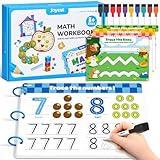
Overview: This reusable math activity book combines 48 wipe-clean pages with 10 dry-erase markers to create an interactive, sustainable learning experience for children ages 3-5 (though content suits up to age 8). The set includes number tracing, counting, addition/subtraction, patterns, shapes, and sequencing activities. Packaged with a storage bag and cleaning cloth, it’s engineered for repeated use and portability.
What Makes It Stand Out: The eco-friendly, reusable design immediately distinguishes this from disposable workbooks. Tear-resistant pages with rounded corners prioritize safety and durability. The comprehensive 10+ math themes progress from basic tracing to calculations, growing with the child’s abilities. Its travel-friendly format transforms car rides and flights into productive learning opportunities without screens.
Value for Money: At $15.49, the reusable nature justifies the premium over traditional workbooks. The inclusion of 10 markers, cleaning cloth, and storage bag adds approximately $8-10 in value. While initial cost exceeds single-use alternatives, unlimited practice opportunities make it more economical long-term. Parents save on repeatedly buying new workbooks for the same concepts.
Strengths and Weaknesses: Strengths include exceptional portability, unlimited practice attempts, screen-free engagement, safety-focused design, and comprehensive math topics. The marker set encourages color exploration. Weaknesses involve markers drying out over time, potential for younger children to mark furniture, and 48 pages offering less breadth than 320-page alternatives. Some children may prefer the permanence of pencil-on-paper.
Bottom Line: An outstanding choice for families prioritizing sustainability and portability. Ideal for travel, waiting rooms, and repeated skill reinforcement. Parents should supervise marker use and stock replacement markers. Best used as a supplementary practice tool alongside structured curriculum.
9. Cltoyvers Wooden Abacus for Kids - 100 Counting Sticks and Number Toys Cards 1-100, Educational Math Games for Preschool and Elementary School 1st 2nd Grade

Overview: This classic wooden abacus modernizes a centuries-old mathematical tool with 100 colorful beads, 110 number cards (1-100), and 100 counting sticks. Designed for preschool through second grade, it provides visual and tactile math learning through bead manipulation and equation building. The sturdy wooden frame features a card slot above the beads to display problems while children physically solve them below.
What Makes It Stand Out: The integration of number cards and counting sticks with the traditional abacus creates a three-tiered learning system. Children can progress from concrete (beads) to representational (sticks) to abstract (cards) understanding. The card slot design is particularly clever, allowing simultaneous display of equations and visual solutions. This multi-component approach supports learners from basic counting through multiplication concepts.
Value for Money: At $14.99, this wooden manipulative set offers strong value for a tool spanning five years of mathematical development. Comparable abacuses without cards or sticks retail for $12-18. The 110 double-sided cards and 100 sticks significantly extend functionality beyond simple counting, making this a single purchase that grows from preschool through early elementary—far more economical than buying age-specific toys.
Strengths and Weaknesses: Strengths include exceptional durability, multi-year usability, comprehensive number range (1-100), BPA-free materials, and effective visual-tactile learning. It brilliantly demonstrates place value and operations. Weaknesses include larger size requiring dedicated storage, small beads posing potential choking hazards for children under three, and loose components (cards/sticks) that can scatter and become lost without organization.
Bottom Line: A worthwhile investment for families committed to hands-on math education. Perfect for Montessori environments and children who learn through manipulation. Best for ages 4+ with organized storage systems. Delivers lasting value across multiple grade levels and children.
10. Let’s Learn: First Math Skills: (Early Math Skills, Number Writing Workbook, Addition and Subtraction, Kids’ Counting Books, Pen Control, Write and Wipe)

Overview: This write-and-wipe workbook focuses on foundational math skills for preschoolers, emphasizing pen control alongside number writing, counting, and basic operations. The reusable format allows children to practice forming numbers correctly and solving simple addition/subtraction problems repeatedly until mastery. Compact and lightweight, it targets early learners ready to transition from manipulatives to paper-based work.
What Makes It Stand Out: The dual emphasis on mathematical concepts and fine motor development distinguishes this resource. While many workbooks teach numbers, the dedicated pen control exercises build the hand strength and coordination necessary for academic success. The write-and-wipe feature encourages risk-free experimentation—children can erase mistakes without frustration, promoting confidence. Its focused scope avoids overwhelming young learners with excessive content.
Value for Money: Priced at $9.99, this reusable workbook offers competitive value. Similar write-and-wipe math books range from $8-15, but often lack the dedicated pen control component. The unlimited practice opportunities provide better long-term value than single-use alternatives. However, the page count appears lower than competitors, potentially limiting content depth for the price point.
Strengths and Weaknesses: Strengths include targeted skill development, confidence-building erasable format, portability, focused curriculum preventing overwhelm, and crucial pen control training. The wipe-clean pages support mastery through repetition. Weaknesses include unspecified page count (likely under 50), lack of included markers requiring separate purchase, and narrow focus that may necessitate supplementary materials for comprehensive learning.
Bottom Line: An excellent supplementary tool for developing number formation and basic operations. Ideal for children struggling with pencil grip or number reversals. Parents must purchase dry-erase markers separately. Best used alongside manipulatives for well-rounded early math education, not as a standalone curriculum.
Why Tactile Learning Transforms Early Math Development
The human brain processes tactile information through specialized pathways that directly connect to memory and emotion centers. When young children engage their sense of touch during learning, they build what developmental psychologists call “embodied cognition”—the understanding that knowledge is constructed through physical experience. This approach proves especially powerful for mathematical concepts, which often feel abstract and disconnected from a child’s lived reality.
The Science Behind Multi-Sensory Learning
Research consistently demonstrates that multi-sensory instruction accelerates learning retention by up to 75% compared to single-sensory methods. When a toddler traces a raised numeral three while saying “three” and placing three buttons in designated slots, their brain forms robust connections between the symbol, the quantity, the motor action, and the auditory label. This integrated experience creates multiple retrieval cues, making the concept more accessible later. The somatosensory cortex, which processes touch, works in concert with the visual cortex and language centers, essentially tripling the neural networks dedicated to that single mathematical concept.
Why Flashcards Fall Short for Young Learners
Flashcards operate on the principle of rapid recognition and recall, which suits older learners but contradicts how young brains develop. Children under six learn best through exploration and repetition with variation—not quick-fire drills. Flashcards present numbers as static symbols divorced from meaning, while a quality tactile book shows that “four” has weight, texture, dimension, and real-world application. The passive nature of flashcard learning also fails to engage the proprioceptive and vestibular systems that help children understand spatial relationships and quantity through physical manipulation.
Key Features That Define Exceptional Tactile Counting Books
Not all interactive books deliver the same educational value. The market includes everything from simple touch-and-feel patches to elaborate engineering marvels with moving parts. Understanding which features genuinely support mathematical development helps you invest wisely.
Material Quality and Durability
Look for reinforced board book construction with thick, laminated pages that withstand pulling, chewing, and vigorous manipulation. Stitching should be tight and concealed, with no small parts that could detach. High-quality silicone, fabric, and textured plastics should feel substantial rather than flimsy. The best tactile elements are inset into the page rather than glued on top, preventing eager fingers from peeling them off. Water-resistant coatings matter because these books often accompany snack time or bath time learning.
Age-Appropriate Design Elements
For the youngest learners, simple, high-contrast designs with one or two textures per page prevent sensory overwhelm. As children mature, books can introduce more complex manipulatives: sliding counters, spinning wheels, or flaps that reveal hidden quantities. The progression should mirror developmental stages—starting with pure sensory exploration and advancing toward purposeful counting and simple problem-solving. Color schemes also matter; younger children respond to bold primary colors, while older preschoolers appreciate more nuanced palettes that challenge their developing color vocabulary.
Interactive Component Variety
The most effective tactile counting books offer diverse interaction types across a single title. This might include fuzzy patches for counting, smooth raised numbers for tracing, grooved paths for finger-tracking, and movable pieces for one-to-one correspondence. This variety prevents habituation—the tendency for children to tune out repetitive stimuli. Each page turn should present a novel way to engage with the same underlying mathematical concept, deepening understanding through multiple representations.
Understanding Age-Appropriate Tactile Elements
Matching book features to developmental stages ensures your child remains challenged but not frustrated. A book perfect for a two-year-old might bore a four-year-old, while advanced mechanics could discourage a younger child.
For Toddlers (Ages 1-2): Sensory Exploration
At this stage, focus on books where textures dominate over complex counting tasks. The goal is associating the word “one” or “two” with a singular, interesting sensory experience. Look for large, easy-to-grasp elements like fur patches, corrugated cardboard, or soft fabric. Numbers should appear as raised, traceable shapes without requiring precise finger control. The narrative, if present, should be simple and rhythmic, creating a predictable pattern that toddlers can anticipate. Books that allow for mouthing and rough handling serve as both math tools and teething toys.
For Preschoolers (Ages 3-4): Purposeful Manipulation
This age group craves agency and control. They want to do something purposeful with the book. Seek out titles with detachable pieces that attach via Velcro or snaps, allowing children to physically remove and replace quantities. Spinning wheels that reveal different groupings, sliders that move objects into counting frames, and flaps that hide and reveal numbers all support developing number sense. The tactile elements should require more precise finger movements—peeling stickers, buttoning small buttons, or lacing through holes—to strengthen fine motor skills alongside numeracy.
For Early Elementary (Ages 5-6): Problem-Solving Features
Older children benefit from tactile books that incorporate simple addition and subtraction through physical manipulation. Look for features like balance scales built into the page, where adding weighted pieces demonstrates equivalence. Books with number lines that children can physically walk their fingers along help visualize magnitude and sequence. At this stage, the tactile elements should support mental math strategies—like using touchable domino patterns to encourage subitizing (instantly recognizing small quantities without counting). The textures become less about pure sensory input and more about representing mathematical relationships.
The Educational Advantages Over Traditional Flashcards
The benefits extend far beyond simply making math “fun.” Tactile books fundamentally change what children understand about numbers and how they relate to the world.
Building Number Sense Through Touch
Number sense—the intuitive understanding of how numbers work—develops through repeated exposure to quantities in various configurations. A tactile book might show the number five as five raised dots in a line, five fuzzy pom-poms clustered together, and five smooth circles arranged like a die pattern. This variety helps children recognize that “fiveness” remains constant regardless of arrangement or texture. They internalize that five is not just the word after four, but a distinct quantity that can be manipulated, separated, and combined.
Language Development Integration
Quality tactile counting books embed rich mathematical vocabulary naturally. As children feel “bumpy,” “smooth,” “ridged,” or “squishy” textures, they develop descriptive language alongside numerical terms. The conversational format of reading together invites questions: “Which texture feels like more?” “Can you find the roughest number?” This dialogue builds comparative language—more than, less than, equal to—that forms the foundation for later mathematical reasoning. You’re not just teaching counting; you’re teaching how to talk about mathematical relationships.
Fine Motor Skill Enhancement
Every zip, snap, button, and slider in a tactile book serves a dual purpose. While children manipulate these elements to demonstrate quantity, they’re also developing the precise finger movements needed for writing numbers later. The pincer grasp required to place a small bead on a peg strengthens the same muscles that will eventually hold a pencil. Occupational therapists often recommend tactile counting books for children with dyspraxia or other fine motor challenges because the motivation to count overrides the frustration of difficult manipulations.
What to Avoid When Selecting Tactile Counting Books
The market’s growth means not every option deserves space on your shelf. Recognizing red flags saves money and prevents educational setbacks.
Overly Complex Designs
Books with too many tactile elements per page create cognitive overload. If a child must process five different textures, three moving parts, and a busy illustration simultaneously, they cannot focus on the mathematical concept. The best designs isolate the learning objective: when teaching the number four, the page shows four identical, prominently placed manipulatives against a simple background. Avoid books where the tactile features become decorative rather than instructional—fluffy clouds that have nothing to do with counting, for instance, distract from the learning goal.
Poor Quality Materials
Beware of books where textures feel chemically treated or where paint flakes off when scratched. Cheap adhesives cause elements to detach, creating choking hazards and ending the book’s usefulness. Test the sturdiness of moving parts in the store if possible; sliders should move smoothly without catching, and spinners should rotate without wobbling. Books manufactured with formaldehyde-based glues or lead-based paints pose health risks, especially since these items frequently contact mouths. Reputable publishers specify safety certifications on the packaging.
One-Dimensional Learning Approaches
Some tactile books simply add textures to traditional flashcard-style layouts—one number per page with a corresponding fuzzy patch. This approach misses the opportunity for deeper learning. The books worth your investment embed multiple ways to interact with each number: trace it, count it, manipulate it, compare it. If a book’s only interactive feature is touching a texture, it won’t sustain engagement or build comprehensive number sense. Look for titles that progress in difficulty within the same book, offering challenges that grow with your child’s skills.
Maximizing Learning Potential at Home
Owning excellent tactile counting books represents only half the equation. Your interaction style determines how much mathematical understanding your child absorbs.
Creating a Multi-Sensory Learning Environment
Place tactile counting books in a designated “math exploration basket” alongside related materials: counting bears, smooth stones, or textured number cards. This invites spontaneous learning throughout the day. When reading together, amplify the tactile experience by adding auditory elements: tap out the rhythm of each number, clap the quantity, or use a small drum. The kitchen offers perfect extensions—counting three spoonfuls of yogurt into a bowl while referencing the book’s page about the number three connects abstract counting to real-life application.
Interactive Reading Strategies
Resist the urge to rush through pages. Instead, adopt a “notice and wonder” approach: “I notice these four buttons feel different from the three on the last page. I wonder why?” Let your child take the lead in exploring textures out of numerical order if that’s where their curiosity leads. The goal is building positive associations with mathematical exploration, not completing the book. Ask open-ended questions that encourage mathematical thinking: “Can you find a way to make these five pieces feel like less?” This prompts creative problem-solving rather than rote recitation.
Extending Activities Beyond the Book
Use the book as a launching pad for sensory bin activities. If the book features counting with sea creatures and textured water, create a bin with blue rice, plastic fish, and scoops for extended counting play. Trace the raised numbers from the book onto paper and have your child match the texture by gluing on sand, rice, or fabric. This reinforces the shape of numerals while connecting the book’s learning to their own creation. Photograph your child interacting with the book’s tactile elements and create a simple “My Counting Book” where they can recall the experience, building narrative memory around mathematical concepts.
Incorporating Tactile Books Into Daily Routines
Consistency matters more than duration. Short, frequent interactions with tactile counting books woven into natural daily rhythms produce better outcomes than scheduled “math lessons.”
Morning Basket Activities
Create a morning basket that includes one tactile counting book alongside a small manipulative like playdough or Wikki Stix. While you prepare breakfast, your child can shape the number of the day from the book, pressing it into the dough to feel its shape. This five-minute routine builds number familiarity without pressure. Rotate books weekly to maintain novelty. The morning light provides excellent visibility for examining textures closely, and the calm start to the day allows for focused exploration.
Quiet Time Learning
Tactile books serve as perfect quiet time companions because they don’t require adult direction after initial introduction. During afternoon rest periods, children can explore at their own pace, repeating favorite pages and discovering new features independently. This self-directed play solidifies learning through repetition and allows children to process concepts without performance pressure. Books with softer textures—velvet numbers, smooth wooden beads—work especially well for this calming time slot.
On-the-Go Math Moments
Keep a small, durable tactile counting book in your car or bag for unexpected waiting times. The physical engagement prevents boredom better than screens and transforms mundane moments—waiting at the doctor’s office, riding the bus—into learning opportunities. Compact designs with attached manipulatives (like beads on a string that slide along the book’s spine) prevent lost pieces while still offering rich interaction. These portable math moments add up to significant learning over time.
Long-Term Value and Investment Considerations
Quality tactile counting books represent a financial investment, but their multi-year utility and educational impact justify the cost when chosen wisely.
Durability vs. Cost Analysis
A well-constructed tactile counting book costing $25 that lasts through three children provides better value than three $8 books that fall apart within months. Examine construction details: Are pages stitched or merely glued? Are moving parts reinforced with metal grommets? Do textures feel permanently embedded? Some publishers offer replacement pieces for detachable elements, extending the book’s lifespan significantly. Consider the cost per use—a book read and manipulated 200 times costs pennies per learning session.
Growth Potential and Replay Value
The best tactile counting books offer layers of complexity that reveal themselves as children develop. A book that begins as a simple texture experience for a one-year-old might later support addition exploration for a five-year-old through its removable pieces. Look for books where the tactile elements can represent different mathematical ideas at different stages. For instance, a page with ten beads might teach counting for a toddler, patterns for a preschooler, and simple division for a kindergartener. This adaptability prevents the book from becoming obsolete.
Resale and Hand-Me-Down Viability
High-quality tactile counting books retain remarkable resale value because they’re in constant demand. Brands known for durability often sell for 60-70% of retail price even after years of use. If you plan to pass books down through multiple children, choose gender-neutral themes and color schemes that appeal broadly. Documenting your child’s interaction with the book through photos creates a learning record that adds sentimental value when gifting to younger siblings or relatives. Proper storage—keeping books away from direct sunlight and extreme temperatures—preserves both textures and resale potential.
Frequently Asked Questions
At what age should I introduce tactile counting books?
You can begin offering simple tactile counting books as early as six months, though purposeful interaction typically emerges around ten to twelve months. Start with books featuring high-contrast colors and large, varied textures. The initial goal isn’t counting but simply associating books with sensory pleasure. By eighteen months, most children can engage with basic one-to-one correspondence activities, like placing one finger on one textured dot. The key is matching the book’s complexity to your child’s developmental stage rather than chronological age.
How many tactile counting books does my child need?
Quality outweighs quantity. Most families benefit from owning three to five diverse tactile counting books that approach numbers from different angles—one focusing on texture, another on manipulation, and a third on sequencing. This variety prevents boredom while covering multiple mathematical representations. Rotate books in and out of active use every few weeks to maintain novelty. Library borrowing supplements your core collection, allowing you to test which features truly engage your child before investing in purchases.
Can tactile books really replace flashcards completely?
For children under six, absolutely. Tactile books teach everything flashcards do—number recognition, quantity association, sequence—while additionally building fine motor skills, mathematical language, and problem-solving abilities. The only scenario where flashcards might supplement tactile books is for quick assessment in a classroom setting, but even then, teachers can observe children manipulating book pieces to gauge understanding. The comprehensive learning experience tactile books provide makes flashcards redundant for early numeracy.
What if my child just plays with the textures and doesn’t count?
This represents normal developmental progression. Young children must first explore materials sensorily before attaching cognitive tasks to them. A child who spends weeks simply stroking the fuzzy patches is building the neural readiness for later counting. Gently model counting without pressuring participation: “I’m counting the bumpy circles: one, two, three.” Over time, your child will internalize the pattern and begin counting independently. Forcing the issue creates negative associations that hinder long-term mathematical confidence.
How do I clean and maintain tactile counting books?
Most quality tactile books wipe clean with a slightly damp cloth and mild soap. Avoid submerging books with electronic components or attached fabric pieces. For fabric elements, use a dry toothbrush to gently remove debris. Periodically inspect all attachments, tightening any loose threads or elements. Store books flat to prevent warping, and keep them away from direct heat sources that could melt adhesives. Some families create “book hospital” kits with fabric glue and replacement Velcro to perform minor repairs, dramatically extending lifespan.
Are digital interactive books just as good as physical tactile books?
Digital books engage visual and auditory senses but cannot replicate the proprioceptive feedback and fine motor development physical manipulation provides. The brain processes digital swipes differently than physical finger movements, with less activation in motor planning regions. However, some hybrid approaches work well—apps that complement physical books by offering extension activities. For foundational number sense, prioritize physical books, using digital versions only as supplementary entertainment during travel or as rewards.
My child has sensory sensitivities. Will these books work?
Tactile counting books offer excellent opportunities for gradual sensory desensitization in a low-pressure context. Start with books featuring subtle textures like smooth wood or soft felt, avoiding highly stimulating materials like scratchy glitter or sticky silicone. Let your child control the interaction, perhaps using a tool like a paintbrush to touch textures initially. Many children with autism or sensory processing disorder excel at mathematical concepts but struggle with traditional instruction methods. Tactile books provide an alternative entry point that respects their sensory needs while building numeracy.
How can I tell if a tactile book is too advanced or too simple?
Watch for engagement cues. If your child becomes frustrated, avoids the book, or needs constant assistance, it’s likely too advanced. If they flip through quickly without stopping to manipulate elements, it’s probably too simple. The sweet spot shows your child lingering on pages, attempting manipulations independently, and showing excitement about discoveries. Some books include age ranges on the cover, but these are guidelines. Your child’s individual developmental timeline matters more than the suggested age.
What’s the ideal budget for quality tactile counting books?
Expect to invest $15-30 for a durable, well-designed tactile counting book. Budget options under $10 often sacrifice material safety and construction quality. Consider purchasing one high-quality book quarterly rather than several cheap ones at once. Many educational toy companies offer subscription services that deliver age-appropriate tactile books monthly, spreading cost while ensuring fresh content. Remember that these books serve multiple developmental domains—math, language, fine motor—making them more cost-effective than single-purpose toys.
Can older siblings use these books with younger children?
Absolutely, and this interaction provides powerful learning for both children. The older sibling practices teaching, which solidifies their own mathematical understanding, while the younger child benefits from peer modeling. Encourage older children to create “challenges” using the book’s tactile elements: “Can you make the number seven using only the bumpy pieces?” This collaborative play builds family learning culture and reduces the pressure on parents to be the sole math educators. Just ensure older children understand the book’s care requirements to prevent damage during enthusiastic teaching sessions.